
[keyword
Contact@agentfrogsmobile.com




[keyword]
Blog > LIQUID PAINT PROTECTION FILM (LPPF)
bLOG > lIQUID PPF
Why Liquid PPF is Replacing Traditional Plastic Film in Sarasota County
Why Liquid PPF is Replacing Traditional Plastic Film in Sarasota County
The Evolution of Automotive Armor
Is Plastic Wrap Dead? LPPF vs. Traditional Film Breakdown
Is Plastic Wrap Dead? LPPF vs. Traditional Film Breakdown
For decades, protecting a high-end daily driver or an exotic supercar from rock chips meant accepting one universal truth: you had to wrap your vehicle in a giant sheet of plastic sticker.
Traditional Paint Protection Film (PPF) undoubtedly changed the game when it first arrived. However, it has always demanded compromises. Installing it requires cutting, stretching, aggressive adhesive backings, and frequently dismantling factory body panels....Today, chemical engineering has evolved past the limits of physical film. The future of automotive surface protection is a solid-state elastomeric armor known as Liquid Paint Protection Film (LPPF).
At Agent Frog’s Auto Studio & Mobile Detail, we pride ourselves on bringing the absolute peak of surface care technology to Sarasota County. Available exclusively by appointment at our private Venice, FL Auto Studio, we are proud to introduce LPPF—a certified revolution in paint protection.
To understand why this technology is systematically replacing old-school film wraps across the luxury automotive landscape, we have to look directly at the chemistry, the performance, and the realities of daily driving in Southwest Florida.

What is Liquid Paint Protection Film (LPF)?
Liquid Paint Protection Film—commonly referred to as LPF or LPPF—is an advanced, liquid automotive armor engineered to deliver the heavy-duty impact defense of a plastic wrap combined with the seamless, flawless aesthetic of a ceramic coating.
Unlike traditional paint protection film, which arrives at a shop as pre-manufactured rolls of polyurethane thermoplastic sheeting, LPF is applied as a highly specialized liquid polymer system directly over a vehicle's paintwork made of polyurethane AND acrylic.
As the material cures, it undergoes a complex molecular cross-linking process. This reaction transforms the liquid into a 4-mil thick, solid-state elastomeric shield that functions as a rugged, secondary clear coat. It is designed to actively absorb and dissipate kinetic energy from road debris, stone impacts, and environmental hazards, entirely eliminating the need for physical adhesives, stretching, or relief cuts.
“Offering the same level of protection at a much reduced cost” — Certified Installer Chuck Fox
Liquid PPF vs. Traditional PPF vs. Ceramic Coatings
To see how Liquid PPF matches up against old-school alternatives at a glance, look at the physical performance metrics across the key categories that matter to vehicle owners:

The Chemistry: Why Thinner is Actually Stronger
The single most common critique from traditional film installers is predictable: "It’s only 4 mils thick; traditional film is 8 mils. It can't protect as well."
This argument fundamentally ignores modern material science, relying on bulk thickness rather than structural density.
Traditional PPF is composed of raw, unreinforced Thermoplastic Polyurethane (TPU). Because raw TPU is relatively soft and lacks high molecular density, the film must be thick to physically absorb and dissipate a rock's impact.
Liquid PPF (LPPF) utilizes a hybrid polyurethane foundation reinforced with advanced acrylic polymers. By cross-linking these two materials at a molecular level, Liquid PPF achieves drastically higher tensile and puncture resistance than unreinforced polyurethane.
In laboratory and real-world road testing, the LPPF's dense atomic structure delivers vastly superior puncture resistance per mil compared to standard film. It doesn't need cumbersome thickness because its molecular bonds are inherently tougher. Traditional shops protect with bulk; we protect with advanced molecular engineering.
The Death of Edges, Seams, and Yellowing
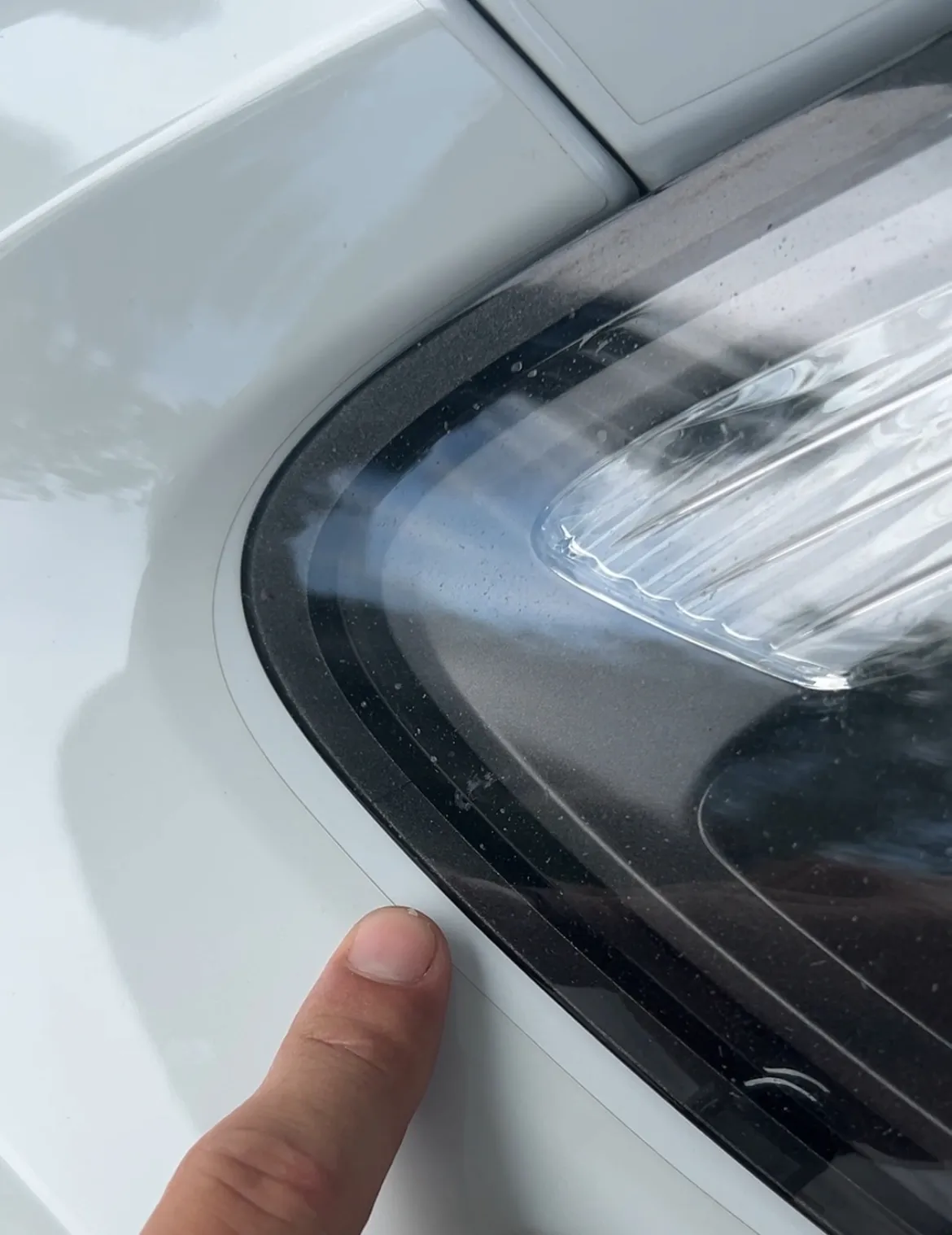
Look closely at any vehicle with traditional plastic PPF that has spent a few years under the intense Florida sun. The flaws are impossible to ignore: dark dirt lines collecting beneath the film edges, lifting around complex aerodynamic vents, and a distinct yellow or hazy tint across white and light-colored paint.
Traditional PPF degrades primarily because of its Pressure-Sensitive Adhesive (PSA)—the glue layer holding the plastic to your car. Over time, Florida’s intense UV radiation bakes this adhesive, causing it to oxidize, blister, yellow, and lose its bond.
Liquid PPF completely eliminates the adhesive layer. Because it is applied as a liquid over the vehicle’s prepped clear coat, it fuses directly with your vehicle's exterior. It cures into a seamless, solid-state film that is completely unified with your factory paint.
Zero Seams: It flows flawlessly into complex active aero ducts, aggressive front splitters, and intricate grilles where traditional film requires ugly relief cuts and seams.
Zero Lifting: Because there are no physical edges, the wind cannot catch or peel the film back—even at track speeds.
Zero Discoloration: Without a chemical glue layer to break down, it will not yellow, fade, or haze. This allows us to offer a robust 10-year manufacturer warranty backed by true material stability.

The Exotic Car Dilemma: Preserving Factory Assembly
Exotic and luxury car owners face a hidden nightmare when dropping their vehicles off for traditional film installation: Disassembly. To hide the edges of a flat plastic sheet on a curved panel, installers routinely strip down a vehicle. They remove factory-torqued bumpers, headlights, door handles, trim pieces, and emblems. For a modern supercar or luxury vehicle, disrupting factory-sealed body panels introduces the risk of interior rattles, electrical sensor faults, or panel misalignment.
Liquid PPF requires zero body panel removal. It is applied directly to the meticulously prepped and masked vehicle. Your exotic or luxury vehicle stays exactly the way it rolled out of the factory, with its pristine body lines enhanced by a completely invisible armor.
Furthermore, while traditional PPF is a temporary, sacrificial layer meant to be eventually torn off and discarded.... Liquid PPF acts as a secondary SELF HEALING clear coat. For clients seeking the ultimate setup, it can be layered with advanced Borophene or Borograph ceramic coatings for unparalleled slickness, hydrophobic performance, and an elite depth of gloss.

Real-World Protection for the Daily Driver
For a daily driver facing highway construction debris, gravel trucks, and love-bug seasons on I-75, Liquid PPF (LPPF/LPF) offers two major structural benefits:
True Thermal Self-Healing
Just like elite-tier traditional films, Liquid PPF features an advanced elastomeric memory layer. If your vehicle picks up swirl marks from routine washing or light micro-abrasions from road grit, you don't need a detailer to buff them out. The intense heat of the Florida sun naturally activates the material, causing the surface to flatten out and erase the scratches automatically.
Instant, Cost-Effective Spot Repairs
If a massive, sharp piece of road debris punctures traditional film, the entire sheet for that panel must be peeled off, thrown away, and replaced at a high cost.
With Liquid PPF, we can perform seamless spot repairs. Because it is a liquid-applied polymer, our certified technicians can flow new material directly into the damaged chip or gouge, cure it, and level it perfectly with the surrounding coat. The repair takes 1 to 2 hours, remains virtually invisible, and costs a fraction of the price of replacing a full panel wrap.
Straight Talk: Addressing the Industry Myths 🤔
Whenever a revolutionary technology threatens a highly profitable, labor-intensive industry, pushback is inevitable. Here is the unvarnished truth regarding the common objections circulating in the detailing industry:
Myth 1: "Traditional installers claim Liquid PPF is a scam and doesn't work."
When ceramic coatings first hit the market over a decade ago, traditional wax shops called them a scam, too. Traditional shops are heavily invested in thousands of dollars of physical film inventory, electronic cutting plotters, and days of tedious manual labor. They are protecting cars with bulk thickness; we are protecting them with cross-linked molecular density. NanoPro LPF is a certified disruption in chemical engineering, fully backed by a 10-year manufacturer warranty.
Myth 2: "Isn’t this just an expensive ceramic coating? How can a spray stop a rock chip?"
Absolutely not. A ceramic coating is microscopic—typically 1 to 2 microns thick—and cures completely rigid and hard like glass to resist UV rays and bird droppings. It cannot absorb a heavy rock impact. Liquid PPF is a liquid elastomer that builds a physical, heavy-duty barrier curing to a 4-mil thickness (thousands of times thicker than a coating). It remains rubbery and flexible under the surface, stretching and absorbing impact energy exactly like a traditional film wrap does
Myth 3: "If it costs less than traditional film, it must be an inferior product."
In the luxury car world, you usually get what you pay for. But with Liquid PPF, you aren’t paying less for a worse product; you are paying less because the installation process is highly efficient...
When you pay $7,000+ for a traditional film wrap, roughly 70% of that bill is pure manual labor, materials & software. You are paying for a technician to spend 40 hours dismantling your vehicle and hand-stretching plastic sheets over body panels. Liquid PPF is applied uniformly without tearing your factory bolts apart. You pay for the elite chemistry and advanced material design—not days of tedious physical body panel manipulation.
Our Policy on Longevity
At Agent Frog’s Auto Studio, we build our reputation on absolute transparency. While the advanced chemistry of LPF carries a robust 10-year manufacturer warranty, we do not market or sell any surface treatment as a "permanent, everlasting miracle." We back the manufacturer's warranty fully, but we educate our clients on proper maintenance to ensure their investment handles the grueling Florida elements beautifully for the long haul.
Straight Talk: 🤔Addressing the Industry Myths
Whenever a revolutionary technology threatens a highly profitable, labor-intensive industry, pushback is inevitable. Here is the unvarnished truth regarding the common objections circulating in the detailing industry:
Myth 1: "Traditional installers claim Liquid PPF is a scam and doesn't work."
When ceramic coatings first hit the market over a decade ago, traditional wax shops called them a scam, too. Traditional shops are heavily invested in thousands of dollars of physical film inventory, electronic cutting plotters, and days of tedious manual labor. They are protecting cars with bulk thickness; we are protecting them with cross-linked molecular density. NanoPro LPF is a certified disruption in chemical engineering, fully backed by a 10-year manufacturer warranty.
Myth 2: "Isn’t this just an expensive ceramic coating? How can a spray stop a rock chip?"
Absolutely not. A ceramic coating is microscopic—typically 1 to 2 microns thick—and cures completely rigid and hard like glass to resist UV rays and bird droppings. It cannot absorb a heavy rock impact. Liquid PPF is a liquid elastomer that builds a physical, heavy-duty barrier curing to a 4-mil thickness (thousands of times thicker than a coating). It remains rubbery and flexible under the surface, stretching and absorbing impact energy exactly like a traditional film wrap does
Myth 3: "If it costs less than traditional film, it must be an inferior product."
In the luxury car world, you usually get what you pay for. But with Liquid PPF, you aren’t paying less for a worse product; you are paying less because the installation process is highly efficient...
When you pay $7,000+ for a traditional film wrap, roughly 70% of that bill is pure manual labor, materials & software. You are paying for a technician to spend 40 hours dismantling your vehicle and hand-stretching plastic sheets over body panels. Liquid PPF is applied uniformly without tearing your factory bolts apart. You pay for the elite chemistry and advanced material design—not days of tedious physical body panel manipulation.
Our Policy on Longevity
At Agent Frog’s Auto Studio, we build our reputation on absolute transparency. While the advanced chemistry of LPF carries a robust 10-year manufacturer warranty, we do not market or sell any surface treatment as a "permanent, everlasting miracle." We back the manufacturer's warranty fully, but we educate our clients on proper maintenance to ensure their investment handles the grueling Florida elements beautifully for the long haul.

The Agent Frog Craftsmanship Process
We don't just apply LPPF to your vehicle and pull it out of the bay. Delivering a top-tier finish requires a meticulous, multi-stage clinical process inside our climate-controlled Venice studio:
Stage 1: Decontamination & Multi-Stage Wash – We strip away all road tar, iron deposits, and environmental fallout from the clear coat.
Stage 2: Precision Paint Correction – Because Liquid PPF locks in your paint's condition permanently, our master detailers execute an intensive paint correction to eliminate swirl marks, scratches, and oxidation before locking in the finish.
Stage 3: Micro-Masking & Prep – We meticulously mask off all glass, rubber seals, and trim to guarantee the liquid armor lands exclusively on your paintwork. No factory bolts or panels are ever removed.
Stage 4: Controlled Layer Application – Utilizing precision equipment, we apply the LPPF in a dust-free environment, allowing the polymers to cross-link directly with your factory clear coat to form a 4-mil barrier.
Stage 5: Curing & Inspection – The vehicle undergoes a controlled thermal cure, followed by a rigorous multi-point inspection under high-intensity lighting before delivery.
Frequently Asked Questions
Q: What happens if I get a rock chip or get into an accident? Can Liquid PPF be touched up?
A: Yes, and this is one of its single greatest advantages over old-school plastic wraps. If a massive piece of road debris punctures traditional film, the entire sheet for that panel is ruined; it must be peeled off, thrown away, and completely re-wrapped at a high cost. Because LPPF is a liquid-applied polymer, we can perform seamless, localized spot repairs in 1 to 2 hours. Our certified technicians flow fresh material directly into the chip, cure it, and level it flush with the surrounding coat—making it virtually invisible without redoing the whole car. In the event of an accident requiring bodywork, the body shop repaints the panel as normal, and Agent Frog simply reapplies the LPF layer to that specific panel (which is typically covered by your insurance provider).
Q: How does time affect Liquid PPF? Will it crack, yellow, discolor, or peel off over the years?
A: Traditional plastic film degrades, cracks, and turns yellow because of its adhesive glue layer. Over 3 to 5 years under the intense Florida sun, that glue oxidizes and loses its bond. NanoPro LPF has zero adhesive glue. Because it is a hybrid polyurethane-acrylic cross-linked polymer, it fuses uniformly with your factory clear coat into a solid-state shield. It is chemically immune to the blistering, cracking, shrinking, or yellowing that plagues traditional film wraps. This structural stability is exactly why it carries a robust 10-year manufacturer warranty against environmental degradation.
Q: What is the removal process? Can I just buff it off, and will it ruin my factory paint or require a repaint afterward?
A: Because Liquid PPF cures into a dense, ultra-tough elastomeric armor, you cannot simply "buff it off" with standard compounds or DIY gear—its tensile strength is far too high. Attempting to aggressively machine-buff it off without the correct process risks overheating and burning your actual factory clear coat. There is no real reason for removal- However, it can be removed cleanly and safely. If you ever want it removed (e.g., for a lease return or vehicle resale), a certified NanoPro installer uses specialized, dedicated chemical releasing agents engineered to safely break down the cross-linked polymers. It dissolves cleanly right back down to your pristine, original factory clear coat. Your factory paint will be completely unharmed and will require zero repainting or touch-up work, revealing the exact same flawless finish it had the day we locked it down.
Q: How do I wash my vehicle after it is coated with Liquid PPF?
A: You can wash it exactly like a traditionally coated vehicle. We recommend a standard two-bucket hand wash method using a pH-neutral automotive shampoo. Because it has thermal self-healing properties, minor micro-abrasions from washing will disappear when exposed to the Florida sun.
Q: Can I apply Borograph or ceramic coatings over it?
A: Absolutely. In fact, we highly recommend it. Layering a premium Borophene or Borograph ceramic coating over your Liquid PPF creates the ultimate automotive armor: maximum impact resistance from the LPPF, combined with extreme slickness, hydrophobic performance, and self-cleaning properties from the coating.
Q: Do you serve areas outside of Venice, FL?
A: While our specialized application equipment requires the controlled environment of our Venice Auto Studio for the installation of Liquid PPF, we routinely serve discerning clients across Sarasota County, including Lakewood Ranch, Bird Key, Longboat Key, and Sarasota.

Secure Your Private Studio Appointment
Because Liquid PPF requires a meticulously controlled environment for application, curing, and multi-stage paint correction, this service is exclusively available by appointment at our Venice Auto Studio.
Turnaround times are exceptionally efficient: 4 to 6 hours (up to 2 days max) for front-end installations, and 1 to 3 days for full-body packages, depending on the initial condition of your factory paint.
Ready to protect your investment with the next generation of surface armor? Contact Agent Frog's Auto Studio & Mobile Detail today to schedule your mandatory in-person paint inspection.
Call or Text Directly: 941-207-0932
Studio Location: Venice, FL (Serving Venice, Nokomis, Sarasota, North Port, & Englewood)
Real Results: Jobs in Venice & Sarasota County
Contact Us
Hours
Social Media
Serving Sarasota, Manatee & Charlotte County
Contact@agentfrogsmobile.com
941-303-3747
Monday - Saturday: 8:00 AM - 6:00 PM
Sunday: 8:00 AM - 12:00 PM




Contact Us
941-303-3747
Serving Sarasota County
& Surrounding Areas
Service Hours
Monday - Friday: 9:00 AM - 6:00 PM
Saturday: 10:00 AM - 4:00 PM
Sunday: Closed
Social Media



2026 | Agent Frog's Mobile Detail | Rights Reserved